
A comprehensive guide for retailers
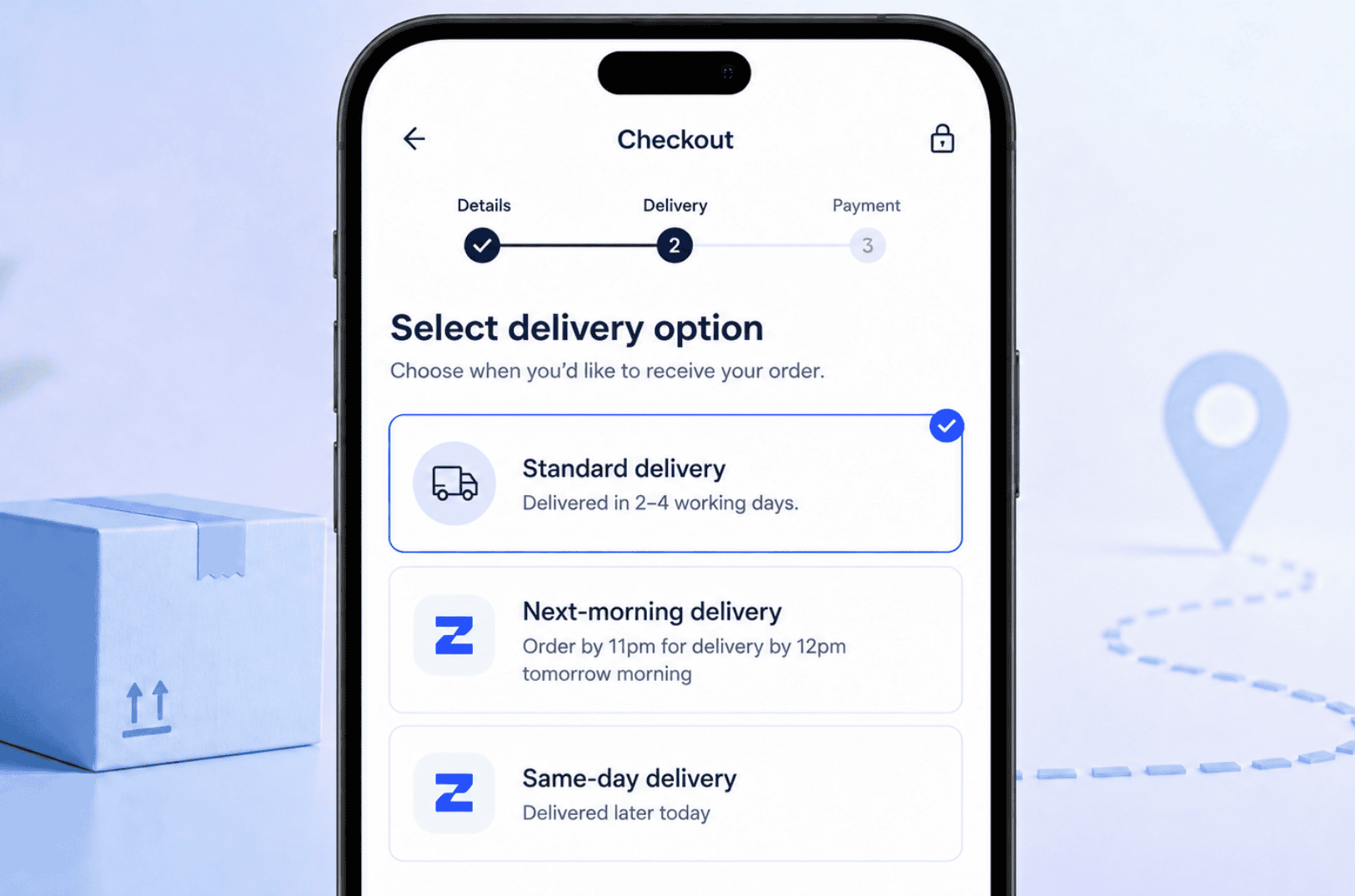
Rapid delivery only makes commercial sense when it meaningfully changes customer behaviour and can be offered at a viable cost to consumers.
Zippd’s Instant Commerce Index 2026 found that one in three consumers are more likely to buy when same-day delivery is available, while one in five would consider switching brands for faster delivery options.
The research shows, however, faster delivery alone is not enough. Cost remains a major factor in delivery choice, and demand varies by category, customer demographic and purchase occasion.
For retailers, there are two questions to consider:
Where is speed most likely to influence acquisition, conversion or customer choice?
Do the economics allow the service to achieve meaningful adoption?
This guide looks at the factors that determine the business case: consumer demand, relevant use cases, pricing, delivery economics and reach.
In this guide, rapid delivery means ecommerce delivery faster than traditional next-day services, including:
Next-morning delivery: Faster than standard next-day, delivered by 12 pm the day following the order
Same-day delivery: Orders delivered on the day that they are placed
Sub-two-hour delivery: Ultra-rapid delivery within two hours of ordering, often enabled by localised inventory or urban fulfilment models
The right service level depends on the product, customer and purchasing occasion.
The data from Zippd’s Instant Commerce Index shows meaningful demand for faster fulfilment, though it is not uniform across every customer or category.
The data shows that:
1 in 3 consumers are more likely to buy when same-day delivery is available
1 in 5 consumers would consider switching brands for faster delivery
Among 25-44-year-olds, more than 40% are more likely to buy from a brand offering same-day delivery
Demand for sub-two-hour delivery is strongest among 18-34s, with electronics, fashion and beauty showing the strongest interest outside of grocery.
A retailer with a younger audience, high ecommerce volumes and products linked to high excitement, urgency, convenience or impulse is likely to see a very different demand profile to one serving customers in a slightly older age bracket with less time-sensitive purchasing behaviour.
The business case should be challenged from the start:
Do our core customers prioritise speed and convenience?
Are there enough purchasing occasions within our category where faster fulfilment could influence their decision?
Faster delivery can influence conversion, but its impact depends heavily on the purchase occasion. Speed is most valuable when waiting creates friction, weakens intent, or risks losing the sale:
Product launches and drops, where immediacy helps sustain excitement
Replenishment, for example of beauty, health and wellbeing products bought at short notice
Impulse purchases, particularly trend-led or viral products
Urgency or replacements, such as replacing a lost or broken phone or another essential item
Upgrades and activations, such as a phone upgrade being delivered and activated same day, without needing to go in-store
Time-sensitive occasions, such as weddings, holidays, events or nights out
Gifting and seasonal demand, where confidence in receiving the item on time matters
Zippd’s research found that nearly 30% of consumers are more likely to impulse buy when faster delivery is available, rising to 33% among 18-44-year-olds, reinforcing the role speed plays in emotionally driven or time-sensitive purchases.
Consumers are willing to pay for rapid delivery, but price still matters.
Zippd’s Instant Commerce Index 2026 found that more than 60% of consumers are willing to pay something for same-day or next-morning delivery, while 1 in 5 consumers aged 44 and under would pay more than £5. At the same time, cost remains one of the most important factors in delivery choice.
That creates an important distinction for retailers. The question is not simply:
“Will some customers pay a high premium for same-day delivery?”
but
“How can we activate rapid delivery in a way that meaningfully influences conversion, customer experience and commercial performance at scale?’
If rapid delivery is positioned as an expensive premium service, adoption is likely to be concentrated among a smaller group of customers and use cases, limiting its impact on the wider ecommerce proposition.
A lower cost-to-serve gives retailers more flexibility to price rapid delivery closer to standard services, offer it for free or at a discount above a minimum spend, include it within a membership proposition or subsidise it around key promotions or trading moments.
The more accessible the proposition becomes, the greater the opportunity to drive adoption and influence conversion, AOV and customer retention.
The key is finding the point where price, adoption, and cost-to-serve work together strongly enough to enable rapid delivery and achieve a commercial return.
The commercial case for rapid delivery depends on whether genuine customer demand and relevant purchasing occasions can be matched with viable pricing, an efficient delivery model and meaningful customer reach.
Five factors to assess:
Demand: Do our customers genuinely value speed and convenience?
Use case: Are there products or purchasing occasions where speed is likely to influence purchasing decisions?
Customer economics: Can you offer rapid delivery at a price point that encourages adoption without undermining margin?
Reach: Can enough of your customer base access the service for it to have a meaningful commercial impact?
Delivery partner: Can your chosen provider achieve the cost-to-serve and flexibility needed to make that pricing viable?
Explore Zippd’s rapid delivery services to see how same-day, next-morning and sub-two-hour delivery can be added alongside existing carrier networks.
The strongest business cases are where these factors reinforce one another: clear customer demand, relevant use cases, viable economics, an efficient delivery partner and enough reach to make an impact. Retailers shouldn’t implement faster delivery for the sake of doing so. They activate the service in a way that generates enough customer and commercial value to justify its cost.
Download the rapid delivery checklist to determine whether rapid delivery is commercially viable for your operation and where further validation may be needed.
Electronics, fashion and beauty show some of the strongest consumer interest outside grocery, according to the Instant Commerce Index. However, suitability depends less on category alone and more on customer behaviour, purchase urgency and whether faster fulfilment can influence the buying decision.
No. The priority is reaching enough of the right customers for the service to create commercial value. Some delivery models are better suited to particular locations; for example, dense urban areas are more favourable for sub-two-hour delivery because customers and stops are concentrated more closely together.
Not necessarily. One in five consumers say they would consider switching retailers for significantly faster delivery, so the more important question is how your proposition compares with competitors. For some retailers, same-day may be the right answer. For others, moving from next-working-day to next-morning delivery, offering seven-day delivery or extending order cut-off times may be enough to create a stronger customer proposition.
The Zippd Instant Commerce Index 2026 is based on research among 2,050 UK consumers conducted in May 2026 in partnership with Research without Barriers. The sample was nationally representative by age, gender and region.